
Check out our latest products
Hello my beautiful friends! Today I’m sharing my Laura Geller Baked Balance-n-Brighten Foundation review with you. Last time I reviewed this foundation was 2011, it’s now 2026, and unfortunately, very little has changed. I want to talk about this foundation that I genuinely love, and a problem with it I can’t stop thinking about. Laura Geller’s Baked Balance-n-Brighten Color Correcting Foundation is one of the gentlest, most skin-friendly powder foundations I have ever tried. It is also one of the least inclusive shade ranges I have seen from a major beauty brand in 2026, and as someone who has been an Indie Makeup Expert covering foundation since 2008, I think we need to have an honest conversation about why this is happening with such a beloved formula. This Laura Geller Baked Balance-n-Brighten Foundation Review is a long time coming.
Where to BuyLaura Geller, Ulta, QVC, Amazon
Laura Geller Baked Balance-n-Brighten Foundation Review
This post is going to be part rave review, part shade range call-out, and part proposed solution. I own three shades of this foundation and have been wearing it on and off for over fifteen years, so I am speaking from a place of real long-term use. Let’s dive in!
Why I Love the Formula
Before I get into what is not working in this Laura Geller Baked Balance-n-Brighten Foundation Review, I want to be very clear about what is working, because the formula deserves recognition.
The Laura Geller Baked Balance-n-Brighten Foundation is a powder mineral foundation that starts as enchanting swirls of cream pigment, is baked for 24 hours on terracotta tiles in Italy, and is hand-finished into a marbleized pressed powder. Visually, it’s beautiful. It gives buildable light-to-medium coverage with a natural demi-matte finish. I have dry, sensitive, rosacea-prone skin, and finding a powder foundation that does not look chalky, turn cakey, settle into fine lines or pores, accentuate dry patches, or trigger a rosacea flare is genuinely difficult. This formula does none of those things on me.
Baked Balance-n-Brighten has been meaningfully recognized by major organizations. It’s recommended by the National Rosacea Society and was the first foundation to earn a seal of approval from the National Psoriasis Foundation. It is dermatologist-approved, paraben-free, gluten-free, sulfate-free, vegan, and certified cruelty-free by Leaping Bunny, the gold standard of cruelty-free beauty. The ingredient list is genuinely lovely: jojoba seed oil, centella asiatica, green tea extract, and vitamin E. For anyone with reactive skin who has been burned by foundations that promise gentleness and deliver irritation, this one delivers.
It is also a “color correcting” foundation in the truest sense. The marbleized pigments include green, lavender, peach, and yellow tones swirled together, so when you apply it, the product does some of the work of neutralizing redness and sallowness for you. For my cheeks (where my rosacea is most prominent), this is a small daily miracle. The finish looks like skin, not like makeup sitting on top of skin, and that is rare in the powder foundation category. It’s not powdery, cakey, or heavy.
So yes, the formula is a winner. Which makes the next part of this post genuinely painful for me to write.
Ingredients listing as of 2026
Porcelain, Fair, Light, Golden Medium, Deep, Toffee: MICA, TALC, NYLON-12, DIMETHICONE, ISOPROPYL PALMITATE, POLYSORBATE 20, MAGNESIUM ALUMINUM SILICATE, CAPRYLYL GLYCOL, LAUROYL LYSINE, OCTYLDODECYL STEAROYL STEARATE, CETEARYL ETHYLHEXANOATE, SORBITAN STEARATE, ACRYLAMIDE/SODIUM ACRYLOYLDIMETHYLTAURATE COPOLYMER, TOCOPHERYL ACETATE, HEXYLENE GLYCOL, AQUA / WATER / EAU, SIMMONDSIA CHINENSIS (JOJOBA) SEED OIL, ISOHEXADECANE, PROPYLENE GLYCOL DICAPRYLATE/DICAPRATE, HELIANTHUS ANNUUS (SUNFLOWER) SEED OIL, POLYSORBATE 80, SORBITAN OLEATE, SYNTHETIC FLUORPHLOGOPITE, CALCIUM SODIUM BOROSILICATE, CENTELLA ASIATICA EXTRACT, CALCIUM ALUMINUM BOROSILICATE, CAMELLIA SINENSIS LEAF EXTRACT, SILICA, TOCOPHEROL, TIN OXIDE, PHENOXYETHANOL, SODIUM DEHYDROACETATE. MAY CONTAIN / PEUT CONTENIR (+/-): TITANIUM DIOXIDE (CI 77891), IRON OXIDES (CI 77491, CI 77492, CI 77499), CHROMIUM OXIDE GREENS (CI 77288), RED 7 (CI 15850).
The Current Shade Range
So many light shades, but not inclusive.
No Laura Geller Baked Balance-n-Brighten Foundation Review would be complete without laying out every single shade in the range, along with the undertone descriptions directly from Laura Geller’s website:
Porcelain — pale skin with rosy undertones
Fair — fair skin with neutral undertones
Light — light beige with warm yellow undertones
Medium — medium skin with neutral undertones
Golden Medium — medium skin with olive undertones
Sand — deep olive skin with golden undertones
Tan — medium deep skin with neutral undertones
Deep — deep skin with golden undertones
Toffee — very deep skin with neutral undertones
That is only nine shades. In 2026. From a brand that has been around since 1997 (her makeup studio opened around 1993) and is sold on Amazon, QVC, at Ulta, and direct-to-consumer worldwide. For context, Fenty Beauty launched with 40 shades in 2017 and now offers 50. Il Makiage offers 50. Even mainstream drugstore brands like Maybelline Fit Me routinely carry 30+ shades. Nine shades is not a starting lineup, it is the entire range, and that’s appalling.
My Three Shades and What They Tell Me About the Gaps
I am a Bright Winter with very fair, neutral cool skin. I own three shades of this foundation and not one of them is a true match for me, which is wild considering that I am supposed to be squarely in the “pale skin” portion of the range that has the most representation.
I’m wearing Laura Geller Baked Balance-n-Brighten Foundation in Porcelain here. You can see how it is a warm pink and the wrong shade for me.
Porcelain
Porcelain is officially described as pale with rosy (pink) undertones. On me it reads decidedly warm pink. My undertone is neutral leaning cool blue, not rosy, and Porcelain pulls warm pink on my skin in a way that emphasizes any redness rather than balancing it. For someone with rosacea, a pink-leaning foundation is the last thing I need. It does not look flattering on my skin tone.
Wearing Laura Geller Baked Balance-n-Brighten Foundation in Fair here. You can see how it is deeper than my skin tone by comparing my hand and arm to my face.
Fair
Fair is the closest to my undertone because it is described as neutral, but it is too deep. The depth difference between Porcelain and Fair is significant, and there is nothing in between. I have tried mixing Porcelain and Fair, but then I look even more orange.
Medium
Medium is several shades too deep for me as a foundation, but I picked it up because the marbleized pigment makes it a fantastic contour powder for fair skin. It gives a soft, diffused, natural-looking shadow that sometimes works for me. So while I am not wearing it as a foundation, I am getting genuine use out of it.
What none of these three shades can do is actually match my face the way a foundation is supposed to. And here is the kicker: I am the demographic this brand most explicitly serves. I am over 40, I have visible texture, fine lines, dry skin and rosacea. I am exactly who this product was designed for. And there is no shade for me.
See a Weekend Getaway Routine featuring Fair and Medium
A weekend getaway routine from 2024 featuring the shades Fair and Medium. In the video you see me use Medium around the perimeter of my face and on my cheekbones, and then I fill in the rest of the face with a very light hand using shade Fair.
Foundation Swatches
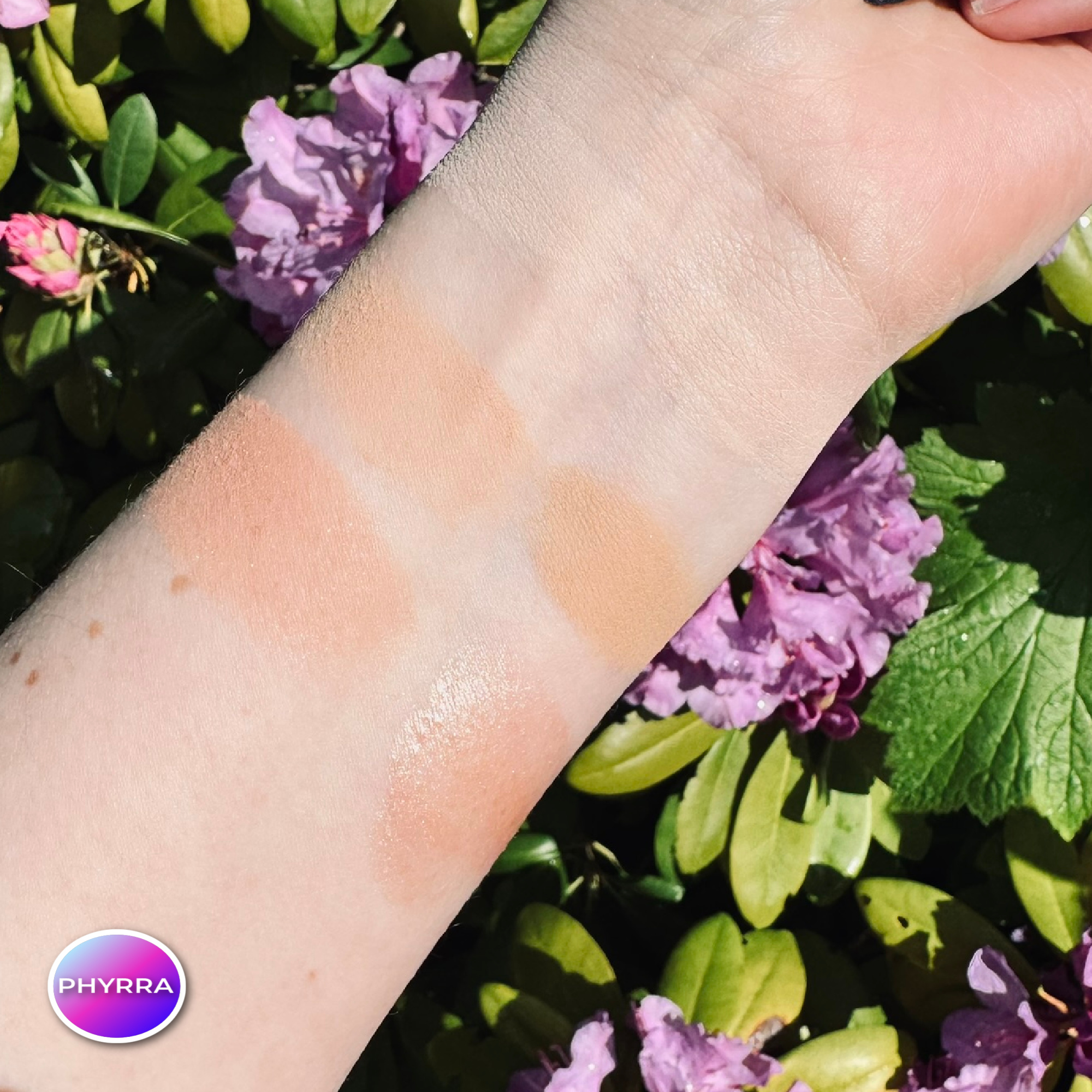
I swatched the three Laura Geller foundations next to some of my other powder formulas. Read the article here!
Laura Geller’s Own Shade Advice Exposes the Gap
Laura Geller’s own product page acknowledges that customers may need a different shade depending on the season. The FAQ notes that Laura herself wears anything from Light to Golden Medium depending on how tan she is in summer, and suggests that anyone who falls between shades may want to buy one as a “summer” shade and one as a “winter” shade.
That advice only works if your seasonal variation happens to fall within the existing shade gaps. For me, my “winter” shade would need to sit lighter than Porcelain, and that shade does not exist.
The brand’s seasonal shade logic assumes that every customer’s baseline skin tone matches one of their nine shades, and that the only variation to plan for is a summer tan, except I can’t tan. But what happens when your true winter skin is paler than Porcelain and your true winter undertone is cooler than Porcelain? You fall straight into a gap that has no solution. There is no shade lighter than Porcelain, and there is no shade cooler than Fair at all. The seasonal shade workaround only works for customers whose skin tones the brand has already chosen to serve. For the rest of us, it just makes the gap more visible.
Where the Shade Range Falls Short
Looking at the lineup as a whole, there are some glaring structural problems:
One Pale Option
There is exactly ONE option for very fair skin, and it pulls too pink for many of us. Porcelain is the lightest shade depth, and it is described as having rosy undertones. If you are pale and cool but not pink, you are stuck. If you are pale with strong pink undertones from rosacea, ironically, applying a pink-toned foundation can make redness more noticeable, not less. When I’ve worn a full face of Porcelain I’ve had people ask me if I was sunburnt or ill, neither of which I want.
Zero Cool Tones
There are zero true cool-undertone shades anywhere in the range. Look at the descriptions again. Porcelain is rosy, which is a warm pink, not a true cool. Fair, Medium, Tan, and Toffee are neutral. Light is warm yellow. Golden Medium is olive. Sand is golden olive. Deep is golden. The entire warm-to-neutral spectrum is covered, but cool undertones at any depth are not represented at all. Cool-toned skin exists at every depth level, and pretending it does not is a baffling oversight from a brand that markets itself to mature women, who often skew cooler as the skin’s natural warmth fades with age.
No Deep End
The deep end of the range stops far too early. Toffee is the deepest shade and is described as “very deep skin with neutral undertones.” That is one shade for the entire deep-to-very-deep population, with zero options for the deepest skin tones. There is no shade darker than Toffee. None. In 2026. And many people are deeper than Toffee.
No Pale, Fair or Light Olive
Olive is only represented at medium depth. Golden Medium and Sand are the only olive shades, both clustered at the same depth level. Fair olive and deep olive complexions have no options. Porcelain depth olive skin tones exists, as does Fair olive.
This is not a starter range. This is the entire range. And it is built almost entirely around neutral-to-warm-yellow medium depths, with one pale outlier at the top and not enough depth at the bottom.
What Laura Geller Could Add to Fix This
I want to be constructive here, because I genuinely want this foundation to succeed for more people. If I were consulting on shade expansion for this product (and brands, my consultancy door is always open), here is what I would propose adding. I am keeping the existing nine shades and adding eleven more, for an even twenty. That is still a very modest range by 2026 standards, but it would be transformative.
In the Fair range
Alabaster — very fair (pale) skin with neutral cool undertones (this is the shade I need; cool but not pink, with a blue or blue-violet base to neutralize warmth without going rosy)
Snow — very fair (pale) skin with true cool undertones (cool pink instead of warm pink like Porcelain, would serve very fair cool-toned customers who currently have nothing)
Linen — very fair (pale) olive skin (the missing pale olive shade)
Ivory — fair skin with warm peach or golden undertones (for fair warm-toned skin currently stuck between Porcelain and Light)
Light to Medium range
Buff — light to medium skin with cool pink undertones (a cooler counterpart to Light)
Honey — light to medium skin with warm golden undertones (a true warm option between Light and Golden Medium)
Beach — light olive skin with neutral undertones (for the lovely olive skin with no option)
Medium to Deep range
Caramel — medium deep skin with warm golden undertones (between Sand and Deep)
Mahogany — deep skin with cool neutral undertones (because deep cool skin exists and is consistently ignored)
Beyond Toffee
Espresso — very deep skin with warm undertones
Onyx — the deepest range, with a neutral undertone (this is honestly the bare minimum needed before the range can claim to be inclusive at all)
Adding eleven shades would not require Laura Geller to reformulate the foundation line. The base formula is already excellent and dermatologist-tested for sensitive skin. The marbleized pigment technique would actually make undertone variation easier than it would be for a single-pigment foundation, since the swirls of color correction can be adjusted to lean cool, neutral, warm, or olive within the same depth. The brand already has the manufacturing relationship in Italy. This is achievable. It just requires the will to do it. Look at brands like About Face with 45 shades, they cover the deepest, fairest, cool and olive skin tones.
Why This Matters
A foundation accepted by the National Rosacea Society and recognized by the National Psoriasis Foundation should be available to every person who lives with rosacea or psoriasis, not just those who happen to fall within a narrow demographic. People of color experience rosacea and psoriasis. Cool-toned people experience rosacea and psoriasis. Deep-skinned people with fine lines and wrinkles deserve a baked foundation that does not crease.
The formula is genuinely special. It is gentle, hydrating, dermatologist-approved, color correcting, vegan, and cruelty-free. Locking that formula away from most of the population because the shade range stops at nine is a missed opportunity for everyone, including Laura Geller as a brand. An expanded range would not water down what already works for the existing customer base. It would make the brand’s strongest product available to people who currently cannot wear it at all.
Who Has Rosacea?
Rosacea affects an estimated 16 million Americans, roughly 5% of the US population, and it impacts women more often than men. Past studies suggested that fair-skinned people of northern European heritage were the most prone to the disorder, but newer research shows that rosacea also affects people in East Asia, Latin America, the Middle East, and Europe.
In Europe, an estimated 14 million people, roughly 5% of the adult population, live with rosacea, though specific countries like Germany may see prevalence as high as 12%, and Ireland as high as 14%.
What’s Their Purchasing Power?
Women are more affected by rosacea than men. Globally, the female-to-male ratio sits at roughly 57 to 60 percent in most studies, which means an estimated 9 million American women and 8 million European women live with this condition. That is close to 17 million women across two of the most lucrative beauty markets in the world, and beauty brands ignore them at their own financial peril. According to a widely-cited Groupon survey, American women spend an average of $3,756 annually on beauty products and services, and 78% of women identify as the primary household shopper.
The numbers get more compelling when you look at women of color specifically. The US Black population represents $1.8 trillion in buying power, with Black women spending an estimated $7.5 billion annually on beauty products and outspending their non-Black counterparts by 80% on cosmetics. The US Hispanic population wields $2.4 trillion in buying power, and Latinx women spend roughly 30% more on beauty than other ethnic groups.
Yet Black consumers are three times more likely than non-Black consumers to report dissatisfaction with their options in haircare, skincare, and makeup. When a foundation accepted by the National Rosacea Society offers nine shades, with zero shades darker than Toffee and zero true cool-toned options at any depth, the brand is not just excluding people, it is walking away from billions in spending power from the exact demographics most likely to need a gentle, color-correcting formula.
European Purchasing Power
The European picture tells the same story. The European cosmetics market was worth €96 billion in 2023, making it tied with the US as one of the two largest beauty markets in the world. UK women alone spend an average of €450 a year on cosmetics, with German women spending around €200, and industry data consistently shows that women account for the majority of beauty spending across major European markets.
The buying power of women of color in Europe is equally significant and equally underserved. The UK’s Black Pound Report found that multi-ethnic consumers in Britain spend 25% more on health and beauty than other consumers, and that 30% of Black women need to rely on specialist shops to find their health and beauty products. Ninety-three percent of multi-ethnic consumers in the UK say brands have a responsibility to approach diversity and inclusivity, and 59% of Black, Asian, and multi-ethnic shoppers say they are more likely to purchase from a brand with an inclusive product range.
Europe is also more racially diverse than its outdated reputation suggests, particularly in the UK, France, Germany, the Netherlands, and Belgium, where significant Black, North African, South Asian, East Asian, and mixed-heritage populations have been part of the beauty consumer base for decades. A foundation sold across the European market with nine shades and zero true cool-toned or deep options is simply not built for the customer base that actually exists here.
Top Questions and Answers about Baked Balance-n-Brighten Foundation
Clockwise from the top: Porcelain, Fair, Medium
Is Laura Geller Baked Balance-n-Brighten good for dry skin?
Yes it is! It contains jojoba seed oil, vitamin E, and centella asiatica, which makes it more hydrating than a typical pressed powder. I still make sure that my skin is prepped and hydrated beforehand. You can also use a hydrating primer like Milk Makeup Hydro Grip Primer. Laura Geller also makes a Spackle Hydrate primer.
Is Laura Geller Baked Balance-n-Brighten good for oily skin?
It can be with the proper skin prep. You will need an oil-controlling primer and will likely need to blot throughout the day.
Is Baked Balance-n-Brighten full coverage?
No. I don’t like full coverage foundations and I gravitate towards light to medium coverage. This mineral foundation is buildable light to medium coverage. LG does make a full coverage version called Double Take Baked Full Coverage Foundation.
What is the difference between Baked Balance-n-Brighten and Baked Balance-n-Glow?
I didn’t like Baked Balance-n-Glow as I felt like it highlighted pores and skin texture, though it’s supposed to have a satin luminous finish. Baked Balance-n-Brighten is demi matte, which looks very natural.
Is Laura Geller cruelty-free?
Yes, Laura Geller is certified cruelty-free by Leaping Bunny, the gold standard in cruelty-free beauty. Baked Balance-n-Brighten is also vegan.
Does Baked Balance-n-Brighten cover rosacea redness?
Yes it does. It usually surprises me how much it can neutralize redness from rosacea. It also has soothing ingredients for angry skin, such as centella asiatica, green tea, and vitamin E. Baked Balance-n-Brighten is accepted by the National Rosacea Society and recognized by the National Psoriasis Foundation, which is rare for a foundation.
How do you apply Baked Balance-n-Brighten?
LG recommends a kabuki brush. I use a dense round foundation brush. I buff in circular motions working from the center of my face outwards. To build up coverage, I stipple and press the powder into my skin. For the lightest coverage, I just sweep it across my face.
How long does the compact last?
If I’m using it every single day, it will last 4 to 6 months. Without daily use, it’s practically immortal as long as it is stored away from heat and humidity. If it smells off or changes how it looks, I would toss it. I think the recommendation on the labeling is 18 months.
Other Laura Geller Products
From top to bottom left – Porcelain Balance-n-Brighten, Fair Balance-n-Brighten. From top to bottom right – Fair Bronze-n-Brighten, Porcelain Glow, Medium Balance-n-Brighten, Nice-n-Natural.
Here are my thoughts on other Laura Geller products. I find all the blushes, even Ethereal Rose, looks warm on me and I do not care for it. I last tried it in 2024. Baked Bronze-n-Brighten Bronzer in Fair has a lovely glow and texture, but I need to apply it with the lightest touch or it turns orange on me. Wonder Balm in Nice-n-Natural is an illuminating cream balm and it’s too subtle for a highlight for me. I’m also not fond of the texture.
What complexion products you recommend if you are cool toned or deeper than Toffee?
I’m wearing LYS Triple Fix Blurring and Hydrating Skin Tint Foundation Stick in LN1. It’s my favorite daily wear complexion product.
Below are my favorite complexion products, the shade I wear in them, and their shade range. These are products that I don’t need to add blue foundation mixer to. They actually match my skin tone. I’ve included my concealer and under eye brightener in this list.
If you are cool toned or deeper than Toffee, you will find matches in LYS, About Face, Haus Labs, and Monika Blunder.
Final Thoughts
To wrap up this Laura Geller Baked Balance-n-Brighten Foundation Review: if you happen to fall within the existing nine shades and your undertone matches one of them, this foundation is one of the best gentle, color-correcting powder formulas on the market and I recommend it without reservation.
If you are like me and you are pale with neutral cool skin that does not match Porcelain or Fair, you will be doing a lot of mixing, layering, and compromising. And if you are anywhere on the cool spectrum at any depth, this range was not made for you. If your skin is deeper than Toffee, this range was not made for you either. And that is a problem the brand can solve.
I would love for Laura Geller to take a serious look at expanding this range. The foundation is too good to be limited to so few people. Until then, I am going to keep talking about this, because shade inclusivity is not a trend, it is a baseline expectation.
Have you tried Baked Balance-n-Brighten? What shade do you wear, and does it actually match your skin? I want to hear from you in the comments, especially if you have ever had to walk away from this foundation because there was no shade for you. Let me know what you would name the shades I proposed too. I am partial to Alabaster, but I am open to suggestions.
Until next time, beautiful friends. Stay weird, stay kind, and demand your shade.
More to See