

Check out our latest products
Hello, beautiful people! Today I’m sharing my honest Polestar 2 review with you and tell you why it turned out to be the perfect electric car for our life in the Netherlands. If you’ve been following me for a while, you might remember way back in 2015 when I wrote about buying a 2015 Toyota Prius 3 in Sea Glass Pearl. That was my stress-free car buying experience in Florida with Dave negotiating like a champion. Well, this time around the car buying journey was driven by a completely different set of needs, and I ended up with a fully electric car that I absolutely love.
The Polestar 2 was purchased by me. All opinions my own.
Polestar 2 Review: Why This Electric Car Is Perfect for Life in the Netherlands
From the Prius to the Polestar 2: Our EV Journey
When Dave and I moved to the Netherlands in November 2025, we knew we would need a car that could handle European roads. I don’t just mean highways; I mean the narrow residential streets, the tiny parking spots at the Albert Heijn, the tight garage entries, and the general reality that everything here is built on a much smaller scale than what we were used to in Florida. My beloved Prius served me well for a decade in the States, but owning an electric car in the Netherlands demanded something different. Something safe, something that could actually fit in a Dutch parking spot, and something with enough doors for Nyx and Amaya to get in and out comfortably.
After weeks of leasing various cars and research, comparing the Polestar 2 vs Tesla Model 3 (neither Dave nor I wanted to give money to Tesla), looking at the BMW i4, the Hyundai Ioniq 5, and the Kia EV6, I kept coming back to the Polestar 2. It checked every box on my list in a way that no other EV could match, which is why I decided to write a Polestar 2 review.
We also tried the Alpine A290, which was adorable and tiny. Unfortunately, its camera system was inferior. While test driving it and trying to park the 360 simulated cameras had issues. So without true 360 cameras, it was a pass for us.
A Note About Renewables
I’ve been in favor of renewable energy as soon as I learned about their existence. In 2000, I thought the USA would lean in on solar panels and wind farms to reduce dependency on oil. Sadly that didn’t happen. I wanted solar panels on our home in Florida, but then we realized we were moving, so we didn’t invest in them. I knew I wanted our next car to be fully electric if possible, because fossil fuels are bad for the planet. I believe if as many people as possible used renewables over fossil fuels, the world would be a better place.
Is the Polestar 2 a Good Car for Dogs?
This might not be the first question most Polestar 2 reviewers tackle, but if you have large dogs, it should be at the top of your list. Nyx and Amaya are standard poodles, about 55 lbs each. When we first arrived in the Netherlands, we leased a Mini Cooper, and while it was fun to zip around in, Amaya had real trouble getting in and out of the car. The door openings on a two-door car like the Mini Cooper just were not big enough for a full-sized standard poodle to navigate without awkward contortion because of Amaya’s hip dysplasia. It was stressful for her and heartbreaking for me watching her struggle. Finding the best electric car for dogs meant prioritizing door size and accessibility above almost everything else.
I knew that whatever car we bought needed to have at least three doors, ideally four, so that both dogs could hop in and out of the back seat without any difficulty. The Polestar 2 is a five-door liftback (which is really just a fancy way of saying hatchback), and the rear doors open wide enough that both Nyx and Amaya can get in and out easily. The Polestar 2 cargo space is good too. With the rear seats up, there is 407 liters of cargo room, and with the seats folded down, you get 1,097 liters. That is plenty of room for luggage, laptops, or a massive haul from the pet store. Problem solved.
Polestar 2 Dimensions: Why Width Matters for European Roads
Here is something I did not fully appreciate until we started living here: most modern cars, especially electric ones, are wide, really wide. My 2015 Toyota Prius was only 1,745 mm wide, and after driving it for 10 years, that was my frame of reference, a small car with excellent turn radius. The Hyundai Ioniq 5 is 1,890 mm wide. The Kia EV6 is 1,880 mm. The Tesla Model Y is a whopping 1,921 mm without mirrors. Even the Hyundai Kona Electric is wider than you would expect. When you are trying to park in a Dutch parking garage where the spots feel like they were designed for microcars, every single millimeter matters.
The Polestar 2 width is 1,859 mm without mirrors, or 1,985 mm with mirrors extended. That might not sound dramatically narrower than the competition, but in real life, those extra centimeters make a noticeable difference while parking and driving. With mirrors folded, it gets even more manageable. For the tight spots we regularly encounter in the Netherlands, at shopping centers, and in parking garages (the Q parks are the worst offenders, why the hairpin turns, why no angled parking spots), the Polestar 2 threads the needle where wider EVs simply cannot. If you are searching for the best electric car for narrow European roads, I think this is where the Polestar 2 dimensions really stand out. A lot of the cars I initially researched were simply too wide for me to feel comfortable driving on narrow roads and parking them on a daily basis, and I crossed them off my list one by one.
Polestar 2 360 Camera: A Must-Have for Tight Parking
This brings me to another non-negotiable feature: the Polestar 2 360 camera system. When your parking spots are this small and the roads are this narrow, you need to be able to see everything around your car when maneuvering at low speeds. Not just a backup camera. Not just rear parking sensors. I needed the full bird’s-eye view that stitches together feeds from four cameras (front, rear, left, and right) to create a top-down view of the car and its surroundings. The cameras have saved me many times from tight parking spots!
The Polestar 2 in the Prime specification comes with this as standard, thanks to the included Pilot Pack. Four cameras provide a 360-degree panoramic view centered around a virtual image of the car on the 11.2-inch center display. The system activates automatically when you put the car in reverse, and you can also turn it on manually at low speeds, which I do sometimes when navigating hair pin turns in tiny parking garages. The camera system is accurate and it has saved me from scraping against tight barriers, posts, and trees more times than I can count. For daily parking in the Netherlands, it is genuinely indispensable for me and Dave.
Polestar 2 Safety Rating: 5 Stars from Euro NCAP and NHTSA
The number one reason I chose the Polestar 2 was the safety features. I wanted the safest car I could get in this size category, full stop. The Polestar 2 safety rating speaks for itself as it has a five-star Euro NCAP rating with a 92% score for adult occupant protection, 89% for child occupant protection, and 86% for safety assist. It also received a five-star NHTSA rating in the United States, with perfect five-star scores across frontal crash, side crash, and rollover protection, but European standards are stricter and more comprehensive than the USA, which I did not know until writing my Polestar 2 review.
My Polestar 2 car is built on Volvo’s CMA platform, and Volvo’s heritage in safety engineering shows. The passenger compartment is constructed with ultra-high-strength steel. There are eight airbags, including a center airbag between the front seats to prevent occupant-to-occupant head injuries in side impacts. There is a SPOC (Severe Partial Offset Collision) block on each front corner that deflects objects away from the cabin and battery pack during angled collisions. The battery pack itself sits in a reinforced steel and aluminum frame, and the high-voltage system automatically disconnects after a collision. Additionally, Dave and I bought a very safe, strong charging cord that you can literally drive over (on accident) and have it still be safe and usable.
On the active safety side, the Polestar 2 Prime comes loaded. Automatic emergency braking with pedestrian and cyclist detection, blind-spot information with steer assist, rear collision warning and mitigation, adaptive cruise control, lane-keeping aid, Pilot Assist for semi-autonomous highway driving, and cross-traffic alert with automatic braking. The auto-assist for driving on the highways and streets is great to me, I set my cruise control to a specific speed, and it keeps my car at that speed but speeds up or slows down depending on the vehicles in front of me. Additionally, the car will hit the brakes to prevent a collision.
Pixel LED Headlights
The car has Pixel LED headlights that use 84 individually controlled LEDs per headlight to shade out up to five areas so you can run high beams without blinding oncoming drivers. This feature is something I use every single time I drive at night on the unlit Dutch roads outside of town, and it is fantastic. I’m grateful to not blind or be blinded by oncoming traffic when driving at night.
Volvo Roots
When I was cross-shopping cars, I kept coming back to the Polestar 2 because no other car in this size and width class matched its combination of active and passive safety features. Volvo has been a founding member of Euro NCAP and has decades of crash research behind it. That expertise transfers directly to the Polestar 2, and as someone who drives on narrow European roads with cyclists everywhere (this is the Netherlands, after all), that level of protection matters to me every single day.
Polestar 2 Specs: The Prime Specification
I went with the Prime specification, which is essentially the fully loaded version of the Polestar 2. Prime bundles together three separate option packs: the Plus Pack, the Pilot Pack, and the Climate Pack. Here is a breakdown of the Polestar 2 specs and features that come standard with Prime. Additionally, we have the Performance Pack.
From the Plus Pack, I get the panoramic glass roof, the Harman Kardon premium sound system, a powered tailgate (a lifesaver when my hands are full of grocery bags or dog gear), fully electric front seats with four-way lumbar support, driver seat memory, and the beautiful black ash deco interior trim. I would have preferred no glass roof, but I didn’t have a choice in that. I really dislike how car companies gate keep certain features or tie them to specific packages.
With the Pilot Pack, I get those all-important 360-degree cameras, adaptive cruise control, Pilot Assist, blind-spot information with steer assist, cross-traffic alert with auto brake, and the Pixel LED headlights with the active high beam technology.
From the Climate Pack, I get heated rear seats (Nyx and Amaya approve, as do our friends), a heated steering wheel (essential for cold Dutch winters), and the heat pump for more efficient cabin heating in cold weather without draining the battery as much.
With the Performance Pack, I get the 50 kW (476 hp/469 bhp) and 740 Nm of torque, accelerating from 0-100 km/h (0-62 mph) in 4.2 seconds. It features adjustable Öhlins dampers, Brembo brakes, and a 60/40 rear-biased AWD system for sporty handling, though the suspension is firm.
All of this comes together in one tidy package. I did not have to agonize over which options to add or worry about whether I was missing something important. Everything I wanted was already included. This is literally the nicest vehicle I’ve ever owned, with prior vehicles including the Toyota Prius Hybrid and Pontiac Aztek.
Polestar 2 Interior and Color: Magnesium Exterior with Scandinavian Minimalism
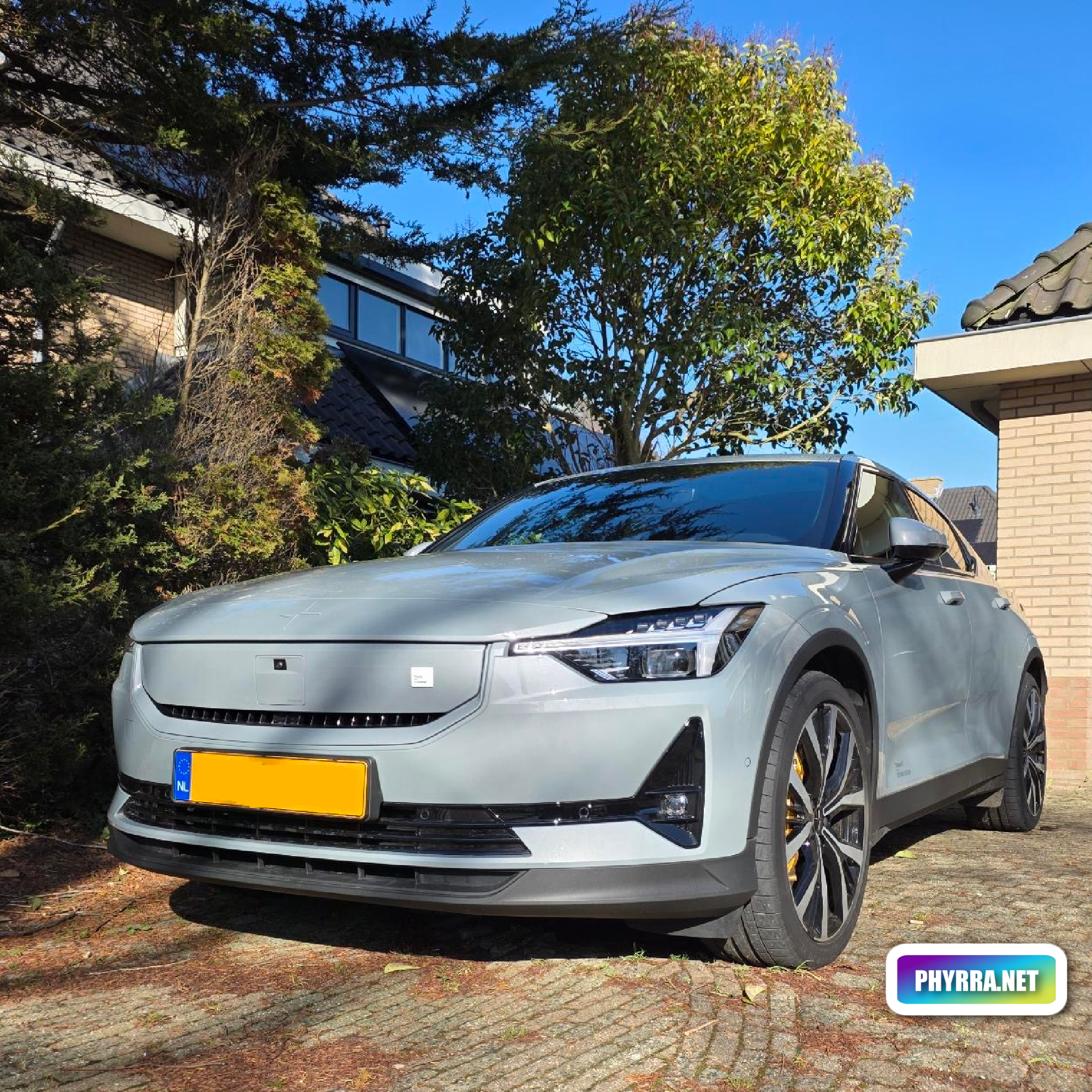
Meet CardEV, our Polestar 2.
My Polestar 2 is in Magnesium, which Polestar describes as a metallic color but which I would honestly describe as a light grey that changes depending on the light. On a bright sunny day, it can look almost white. Under overcast Dutch skies (so, most of the time), it reads as a soft silvery grey. I see a hint of blue in certain lighting, but it’s not a strong metallic paint color. It is a little bit of a chameleon color and I really like that about it. It hides dirt reasonably well compared to darker colors like Void (black) or Midnight (dark blue), which is a practical consideration when you live somewhere that it rains constantly. That said, now that pollen is out everywhere, the pollen is quite visible on the car and I need to wash it, not that pollen is critical to my Polestar 2 review.
I would have loved a more dramatic color option. Something in a deep teal blue or a jewel tone would have been perfect (you know me). But Polestar’s color palette leans very Scandinavian minimalist, all muted tones and sophisticated (and a little boring) neutrals. Magnesium felt like the most interesting choice in the available range, and in person it has a lovely sparkle in the metallic flake that catches the light nicely. I can always get it wrapped or get a multichrome paint job in the future if I change my mind.
The Polestar 2 interior continues that Scandinavian design philosophy. Clean lines, high-quality materials, and a modern aesthetic that feels premium without being flashy. The seats are incredibly comfortable, supportive without being stiff. Everything feels solidly assembled. If you have ever sat in a modern Volvo, you will feel right at home, but with a more minimalist, performance-oriented edge.
Polestar 2 Google Infotainment: The Best In-Car Tech I’ve Used
One of the things that genuinely surprised me about the Polestar 2 was how much I love the Google built-in infotainment system. The Polestar 2 was the first car in the world to feature Google built-in, which means the entire operating system is Android Automotive OS. Google Maps is your native navigation. Google Assistant responds to voice commands. You can download apps from the Google Play Store right on the 11.2-inch center touchscreen. YouTube Music, podcast apps, even audiobook apps are all available.
If you live in the Google ecosystem (and I do), the integration is seamless. Google Maps in the car already knows my saved places. It adjusts routes based on real-time traffic, though sometimes I hate this when I want to drive a specific way somewhere, because I hate going down tiny canal streets. It factors in the car’s battery level and suggests charging stops on longer trips. I can say “Hey Google, navigate to Albert Heijn” or “Hey Google, set the temperature to 21 degrees” without taking my hands off the wheel.
The 12.3-inch digital instrument cluster behind the steering wheel can also display a Google Maps view, so you can glance at the navigation without looking at the center screen. Between the two displays, you have all the information you need without anything feeling cluttered or overwhelming. There are very few physical buttons, but the ones that exist (like the volume knob and steering wheel controls) feel premium and tactile. I would prefer more physical buttons, but so many car manufacturers have moved away from them.
Additionally, I love the Google Maps display that is behind the steering wheel. It makes it easy to glance at the map while paying attention to the road, looking out for pedestrians and cyclists.
Apple CarPlay is also available via USB-C for anyone who prefers that ecosystem. While I have an iPhone, I prefer Google Maps and I use YouTube Premium for my music. It’s so easy to access my playlists in the car.
Polestar 2 One Pedal Driving and How It Drives
The Polestar 2 drives beautifully. It is smooth, quiet, and hugs the road. The Polestar 2 one pedal driving mode is something I got used to within the first day, and now I cannot imagine driving without it, I love it so much! You lift your foot off the accelerator and the car decelerates through regenerative braking, recapturing energy for the battery. In city driving, you barely need to touch the brake pedal. It makes navigating roundabouts (and there are SO many roundabouts in the Netherlands) feel completely natural. Additionally, you can turn off the ‘creep’ feature so that if you’re sitting at a stoplight, you don’t have to hold your foot on the brake, you just take it off the driving pedal.
The hatchback design is something I specifically wanted. Just like my old Prius, the rear trunk door opens to reveal a genuinely useful cargo area. There is also a small frunk (front trunk) under the hood for a charging cable or a small bag. For hauling dog crates, grocery runs, or the occasional IKEA trip, the hatchback format is far more practical than a traditional sedan trunk.
Polestar 2 Charging and Range: Living with an EV in the Netherlands
The Netherlands is a fantastic place to own an electric car, and the Polestar 2 range and charging experience have been excellent for our daily life. The charging infrastructure here is outstanding, especially compared to Tampa. There are public chargers everywhere, at supermarkets, in parking garages, at hotels, gas stations, and on residential streets. We have a home charger, and overnight charging on our regular schedule keeps the battery topped up without any range anxiety. The long-range battery in the Polestar 2 provides enough range for our daily driving needs with plenty to spare.
For longer trips, the Polestar 2 charging capability handles DC fast charging well. Google Maps factors in the battery level and plans charging stops along your route automatically, which takes all the guesswork out of road trips. The car supports up to 205 kW DC fast charging, meaning a 10-80% charge takes around 28 minutes under ideal conditions. We have never been stranded or stressed about finding a charger. The worst part about using a fast charger is having to wait for one to be available, usually it’s been a 5 minute wait but on one occasion it was 20 minutes.
Dutch electricity is also increasingly renewable because they believe in science and reducing climate change, which makes driving electric feel even better from an environmental perspective. There are also practical benefits like lower road tax (motorrijtuigenbelasting) for electric vehicles and free or discounted parking in some municipalities. If I owned my own home, I would be buying solar panels to help with my energy needs. Most homes here have solar panels; sadly the home I’m renting does not.
Polestar 2 vs Tesla Model 3: Why I Chose Polestar
Since this is the comparison most people want to know about, here is my take on the Polestar 2 vs Tesla Model 3 debate. The Tesla Model 3 is a car with impressive technology and it costs less. There is no getting around that. But for my specific needs, the Polestar 2 won out for multiple reasons.
First, the Polestar 2 safety rating edges ahead, along with its 360 cameras. Second, the hatchback design gives the Polestar 2 significantly more practical cargo space than the Model 3’s sedan trunk, which matters when you have two large dogs and their gear. Third, the Polestar 2 interior feels more conventionally luxurious, with better material quality, build quality, and a warmer cabin feel. Fourth, I strongly preferred the Google built-in infotainment over Tesla’s approach. And fifth, the Polestar 2 width is slightly narrower than the Model 3, which makes a real difference in tight European parking.
The Tesla wins on range, on price, and potentially on software innovation. If those are your priorities, the Model 3 is hard to beat. But for what I needed, the Polestar was the right choice.
Polestar 2 Reliability: My Long-Term Owner Experience
I want to be upfront that this is still relatively early in my ownership, so I cannot speak to Polestar 2 reliability over multiple years. What I can tell you is that so far, the car has been trouble-free. The over-the-air software updates have been smooth. The Google infotainment system occasionally has a brief hiccup that requires me to reboot it, but nothing that takes more than two minutes of patience. The car’s build quality feels solid and nothing rattles or squeaks.
Polestar offers a four-year/50,000-mile basic warranty and an eight-year/100,000-mile battery warranty, which gives me peace of mind on the most expensive component. The first three years or 30,000 miles of scheduled maintenance are also included, which is a nice perk.
Winter Warrior
The Polestar 2 is the best car I’ve ever driven in winter conditions on snow and ice. The car almost can’t lose traction because the computers in it immediately adjust and correct. It almost makes you trust it too much. I am not a fan of driving in winter at all, but am grateful that I can safely get around when necessary.
I will update this section as I accumulate more miles and time with the car.
The Bottom Line: My Polestar 2 Review
I bought the Polestar 2 because it was the safest, narrowest, five-door electric car with true 360-degree cameras that ticked every box on my list. Is the Polestar 2 a good car? For my specific needs, it is a great car!
The five-star Euro NCAP and NHTSA safety ratings gave me confidence. The narrow width makes daily parking in the Netherlands manageable instead of nerve-wracking. The five doors mean Nyx and Amaya can get in and out without a struggle. The 360-degree cameras are a genuine necessity for European parking for me. The Prime specification means I did not have to compromise on features. The Google built-in infotainment is intuitive and useful. The one pedal driving mode is addictive! And it drives like a dream.
Is it perfect? No car is. I wish there were more exciting color options. The 360 camera image quality could be sharper. The frunk is tiny. And the rear seat headroom is a bit tight for taller passengers. But for what I needed, which was a safe, practical, well-equipped electric car that could handle daily life in the Netherlands with two big dogs and tight parking, the Polestar 2 is exactly the right car.
To be honest, it’s the vehicle I’ve had the most fun driving in a long time!
If you are considering an EV for life in Europe, especially in the Netherlands where the roads are narrow, the parking is tight, and the infrastructure for electric vehicles is outstanding, I would absolutely recommend taking a look at the Polestar 2.
I thought it was timely to share my Polestar 2 review because Polestar is currently offering up to a $21k lease discount on the 2025 Polestar 3 and up to 14k off a Polestar 4 for customers who currently drive a Tesla.
Have you made the switch to an electric vehicle? What was the deciding factor for you? Let me know in the comments!
More to See